A1 to B1 in Greek: A Realistic Timeline for Citizenship Applicants
Apr 23, 2026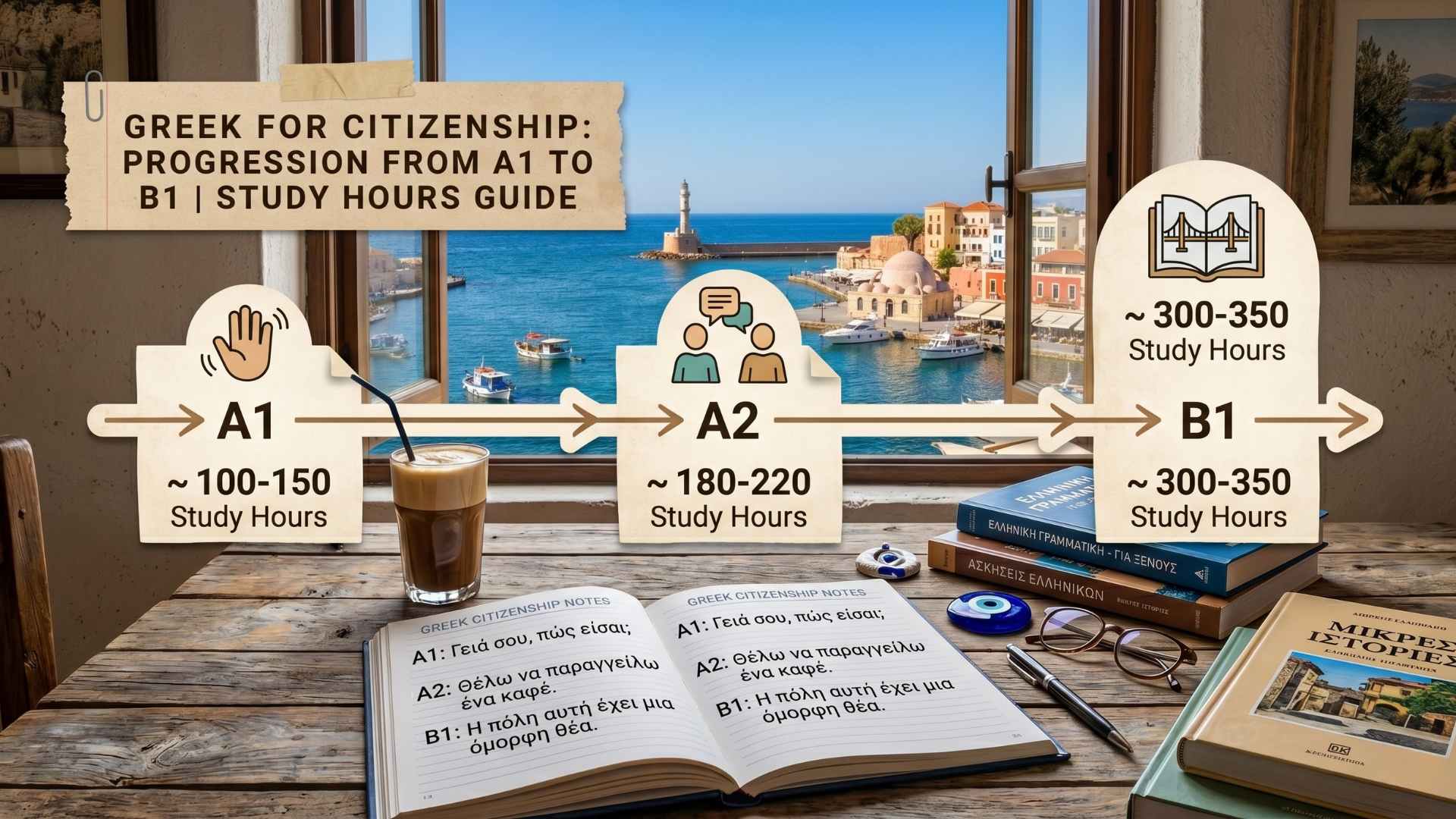
A1 to B1 in Greek: A Realistic Timeline for Citizenship Applicants
By Joaquim Queiroz
Introduction
If you've started looking into Greek citizenship, you already know the language is not optional. The law is clear: you need B1, intermediate level on the Common European Framework, certified by the Center for the Greek Language. No test, no application.
What the law doesn't tell you is how long that actually takes.
Search the question online and you'll get answers that range from "six months if you're motivated" to "1,100 hours minimum, according to the US Foreign Service Institute." Both are technically correct. Neither is useful when you're trying to plan your life.
I'm writing this from Kastoria, in northern Greece, where I live with my Greek wife and children. I'm a native Portuguese speaker, working through A2 toward B1 myself, and my wife Eleni teaches Greek professionally, which sometimes helps enormously and sometimes turns dinner into a surprise grammar quiz. So this timeline is built from two perspectives: the student going through it right now, and the teacher who has guided hundreds of people through the same climb.
This is the realistic version. Not the optimistic one.
Why B1 is the line for citizenship
Before we get into timelines, a quick recap of why B1 specifically matters.
Greek naturalization requires candidates to pass the Πιστοποιητικό Επάρκειας Γνώσεων για Πολιτογράφηση (Certificate of Adequacy for Naturalization). It tests two things: language ability at B1 level, and knowledge of Greek history, geography, culture, and the constitutional system. You need to score 80% to pass, and the exam is held twice per year.
B1 on the CEFR scale means you can:
- Understand the main points of clear, standard speech on familiar topics
- Handle most situations you'd meet while travelling or living in Greece
- Produce simple connected text on topics of personal interest
- Describe experiences, ambitions, plans, and give brief reasons for opinions
In practical terms: you can explain to a doctor what hurts, you can argue with a landlord about a bill, you can read a short newspaper article and get the gist. You're not elegant, but you're functional.
This is considerably more than tourist Greek, and this is why timelines online are so deceptive. The people who say "six months" usually mean A1 or A2 survival level, not B1.
The FSI reality check
The US Foreign Service Institute classifies Greek as a Category IV language for English speakers, the second-hardest tier, the same group as Russian, Turkish, and Polish. Their estimate for reaching Professional Working Proficiency (roughly B2/C1) is 1,100 hours of dedicated study.
B1 is lower than that target. A reasonable extrapolation from FSI data puts B1 at roughly 600 to 750 hoursfor a motivated English-speaking adult with no prior Slavic, Balkan, or classical background.
Before you do the math, a few adjustments:
- If your native language is Romance (Spanish, Portuguese, Italian, French), you have a small advantage with vocabulary. A surprising number of words share roots through Latin or via modern scientific and academic vocabulary. You do not have an advantage with grammar, which is where most of the difficulty lives.
- If you're already in Greece, your passive exposure accelerates listening and pragmatic skills substantially. You'll reach comprehension milestones faster than the raw hour count suggests.
- If you're learning remotely from abroad, add 20% to 30% to every estimate below. Immersion matters more than methodology.
The honest phase-by-phase timeline
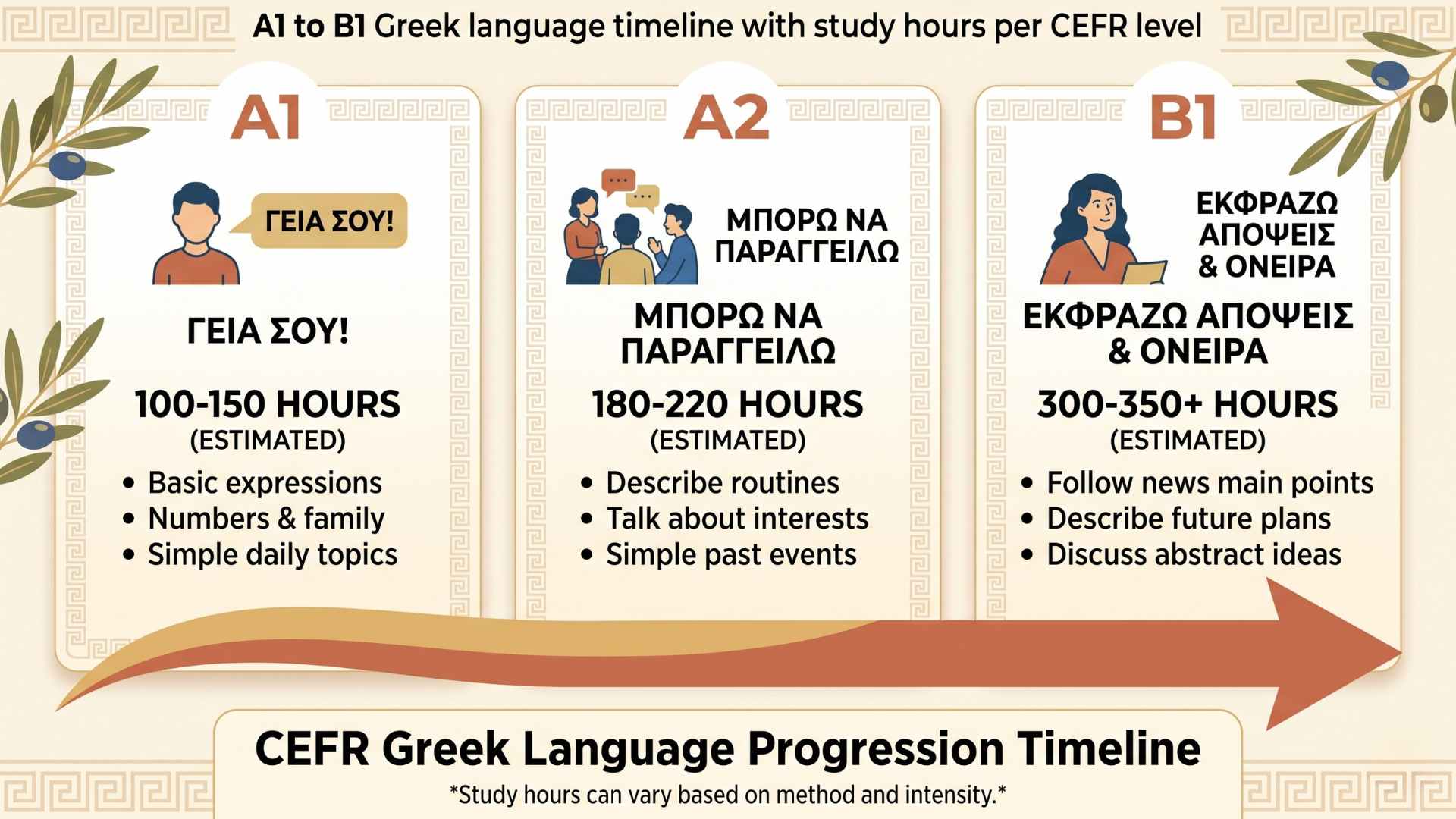
Here is how the journey typically breaks down, in real calendar months, assuming roughly 5 to 7 hours of serious study per week (one or two private lessons plus homework and review). This is the sustainable pace most adults with jobs and families can actually maintain.
Phase 1: A1, complete beginner to survival
Calendar time: 3 to 5 months
Study hours: 80 to 120
At A1, you're learning the alphabet, basic pronunciation, greetings, numbers, present-tense verbs, and simple sentence structure. By the end of A1, you should be able to introduce yourself, order coffee, ask the price of something, and understand very slow, very simple speech about familiar topics.
The real challenge at A1 isn't grammar. It's the alphabet and pronunciation, specifically getting your ear used to the sounds of γ, χ, ντ, μπ, and the stress-accent system. Most students stall here not because it's hard, but because they underestimate how much listening they need to do before speaking feels natural.
My own A1 phase took about eight months, which is on the long end of the range. I'm not going to pretend it was because Greek is hard. It was because I didn't treat it as a priority at first. My remote work was entirely in English and Portuguese, so I had zero daily pressure to use Greek, and the alphabet alone felt exhausting at the end of a workday. Most beginner textbooks in Greece are written entirely in Greek, which is the correct pedagogical approach but brutal when you can't yet decode the letters on the cover.
The thing that actually unlocked A1 for me was getting access to our own self-paced course (yes, I'm biased, but I was skeptical before I started using it). What broke the logjam was having structured lessons in English that introduced the alphabet progressively instead of dumping it on me in one go, with audio for every new word. It sounds basic, but after three failed attempts with other materials, basic was exactly what I needed. Your own unlock might be completely different, a podcast, a patient neighbour, a specific textbook, but the pattern is the same: until you find the format that fits your life, you're not going to put in the hours.
Phase 2: A2, functional basics
Calendar time: 4 to 7 months after A1
Study hours: 150 to 200
A2 is where the language starts to feel real. You learn past tenses (aorist and imperfect), the future tense, the genitive case properly, possessive pronouns, and a large bank of practical vocabulary. You can now handle transactional conversations like pharmacy, bank, appointment scheduling, and understand the gist of short texts.
The real challenge at A2 is the verb system. Greek has two aspects (perfective and imperfective) that English speakers routinely confuse, and the aorist is a minefield of irregular stems. Students who skim this phase pay for it at B1.
This is also the level that qualifies you for long-term residence permits in Greece, which is why many expats stop here. If citizenship is your goal, don't.
Phase 3: B1, independent user
Calendar time: 6 to 12 months after A2
Study hours: 200 to 350
B1 is the long phase. You're consolidating everything from A2 and adding the subjunctive mood (constant use of να), conditional constructions, reported speech, more complex noun declensions, and enough vocabulary to discuss abstract topics such as work, opinions, plans, and experiences.
The real challenge at B1 is endurance. The novelty is gone, progress feels slower because each new structure is a refinement rather than a revelation, and most students hit a plateau around month 8 where they feel like they've stopped improving. They haven't. They're just now in the part of the curve where gains are invisible until suddenly they aren't.
You also need to start dedicating specific time to the citizenship exam format at this stage: essay structure, oral presentation skills, and content knowledge on Greek history and civics. Language ability alone won't pass the exam.
Total realistic timeline
From zero to B1-ready: 13 to 24 months of consistent study.
The wide range is not because some people are naturally gifted. It's because of how much you study per week, how much time you spend in Greek-speaking environments, and whether you have a structured learning path or you're improvising with apps.
What actually slows people down
In our experience with students, the delays are almost always one of these five.
Inconsistent study. Two hours on Sunday and nothing else doesn't work for Greek. The language rewards daily short sessions over weekly long ones. Thirty minutes a day will beat three hours once a week, every time. I've been guilty of this one myself, more than once. The only thing that fixed it was making Greek a non-negotiable habit, the same way I don't skip coffee in the morning. Now I'd rather do fifteen tired minutes than zero.
Learning in isolation. Apps and self-study work for A1. By A2, you need feedback on your speaking and writing, because mistakes that go uncorrected become permanent. This is where most self-learners stall around month 6. For me personally, combining the self-paced course with private lessons was the real turning point. Self-study gives you the structure, but having a teacher who knows your weak spots and can push you into uncomfortable territory every week is what actually moves the needle. It also keeps you accountable, which matters more than most learners admit.
Skipping the alphabet properly. Some beginners rely on transliteration (Greeklish) for too long. This is a short-term comfort that becomes a long-term blocker. You can't read, you can't text naturally with Greek friends, and your pronunciation suffers because you never internalize the letter-to-sound relationship.
Avoiding the hard grammar. The aorist, the subjunctive with να, and the genitive plural are the three checkpoints where most students try to negotiate with the language. The language doesn't negotiate. You either learn them or you stay at A2 forever.
No deadline. Students who register for a specific exam date, even one six months out, progress noticeably faster than students who are "working towards it eventually." Deadlines create compression, and compression creates fluency.
What actually speeds people up
Structured lessons with a real teacher. Not an app, not a YouTube channel, but someone who corrects your sentences in real time and picks which grammar to introduce when. One or two hours of private lessons per week, combined with independent study, is the most efficient ratio we've seen.
Daily passive exposure. Greek radio while you cook. A Greek podcast on your commute. Greek TV with Greek subtitles in the evening. You're not actively studying in these moments, but your brain is calibrating to rhythm, stress, and common vocabulary.
Speaking from day one. Even if it's awful. The students who wait until they "feel ready" to speak never feel ready. The students who speak badly from week one are conversational by month six.
A clear exam target. If citizenship is the goal, pick a specific exam date (May or November) and work backwards. Our most successful B1 candidates registered 8 to 10 months before their exam and built everything around that date.
Where I am right now
I'm currently at late A2, targeting B1 for the May 2027 exam rather than November 2026. The honest reason is that we have a small child at home, and I'd rather over-prepare by six months than register for an exam I'm not ready for. One of the lessons I've picked up from watching students is that failing a B1 attempt costs you more than just the €250 fee. It costs your motivation, and motivation is the expensive resource in this whole process.
The biggest quality leap in my own learning came from the self-paced course Eleni built. I'm not saying that because she built it. I'm saying it because I had already tried three other resources before I used it, and the difference was obvious within two weeks. I then reinforced it with private lessons from the teachers we train at Speak Greekly, who are specifically coached to run dynamic, interactive sessions rather than walking students through a textbook page by page.
That distinction matters more than it sounds. A lot of traditional Greek courses hand you a heavy grammar book, start at chapter one, and grind forward. This works for a small percentage of disciplined students and demotivates everyone else within three months. The courses that actually produce B1-ready students treat the grammar book as a reference, not a curriculum, and build each lesson around speaking, listening, and situations you're likely to encounter this week. That's the model we use, and it's the single biggest reason I've made it from zero to late A2 while also raising two kids and running a company.
My biggest lesson so far: the timeline the internet promises you is always shorter than the timeline you actually need. But the payoff, being able to argue politics with your father-in-law in Greek, is worth every month of it.
If you're serious about citizenship, start now
The single most important thing I can tell anyone planning to apply for Greek citizenship is this: language is not the last step of the process, it's the first. If you need seven years of residence to apply, you have seven years to reach B1. You also have seven years to forget everything twice over if you don't start soon.
B1 is achievable for any motivated adult. It is not achievable by accident, and it is not achievable with Duolingo alone.
At Speak Greekly, we work specifically with expats preparing for the citizenship exam. We offer private lessons, semi-private pairs, and a self-paced course that covers the A1 to B1 progression with citizenship-specific content modules. If you want to see what structured preparation looks like, book a free trial lesson and let's map out your personal timeline.
The fastest way to B1 is the least glamorous one: start this week, study daily, get corrected often, and don't stop. The math takes care of itself.
Join Our Free Trial
Begin your Greek journey today and see how simple and motivating learning can be.
Bring a Bit of Greece to Your Inbox!
Join our mailing list to get weekly language hacks, vocabulary tips, and cultural insights delivered straight to your inbox.
We hate SPAM. We will never sell your information, for any reason.