How to Order Coffee in Greece (in Greek!): A Former Barista’s Guide
Mar 20, 2026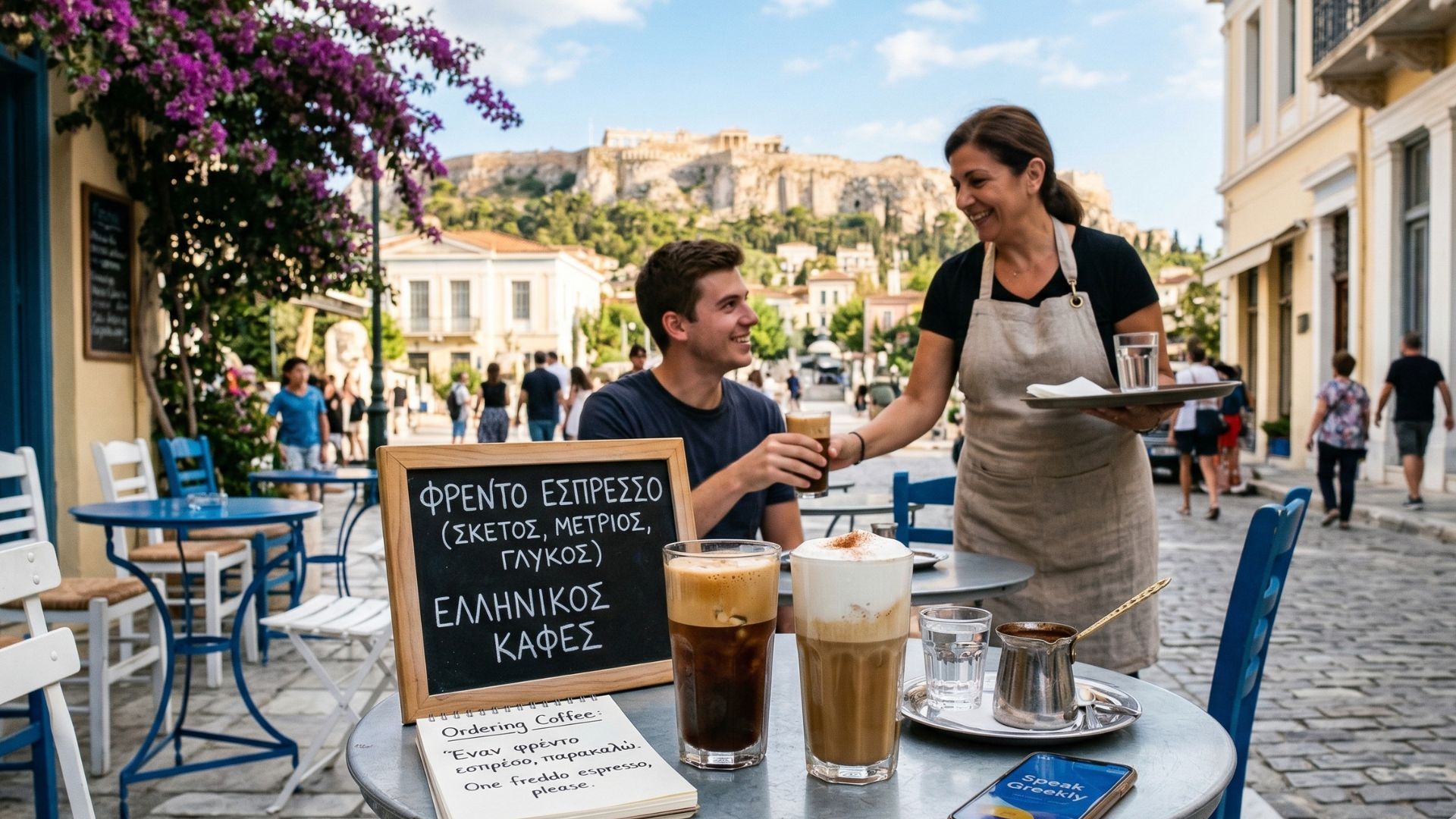
How to Order Coffee in Greece (in Greek!): A Former Barista’s Guide
My journey into the world of coffee didn’t start with a simple cup of joe. It began in Lisbon around 2017, when I stepped into a specialty coffee shop that felt more like a laboratory than a cafe. They roasted their own beans on-site, and the air was constantly thick with the scent of caramelizing sugars and toasted nuts. That ritual of precision, the weighing of every gram, and the pursuit of the perfect extraction quickly conquered me.
I became so obsessed with the craft that I decided to take it to the source of espresso culture: Italy. I enrolled in a professional school that focused not just on traditional techniques but on the "Third Wave" movement. I spent months perfecting latte art, learning the chemistry of milk texturizing, and understanding the nuances of different origins. For several years, my life was a cycle of cupping sessions, calculating extraction yields, and brewing delicate V60 pour-overs. I was a purist who believed coffee should only be served one way.
The Athens Surprise: High-End Gear on Every Corner
In 2022, life changed direction. I moved to Athens with my Greek wife. By then, I had transitioned into the wine industry, trading port filters for wine glasses. However, once a barista, always a barista. My palate was still tuned to quality, and I expected to find a "specialty coffee desert" outside of a few niche spots in the city center.
I couldn't have been more wrong.
The first thing that struck me about Greece was the incredibly high average quality of coffee. In Lisbon, while the specialty scene is top-tier, the average neighborhood "pastelaria" often serves a very dark, bitter, and commercial roast. In Athens, the baseline is different. I found myself walking into unassuming corner shops only to find them equipped with the "Ferraris" of the coffee world: La Marzocco, Slayer, or Victoria Arduino machines. What’s even more fascinating is that many of these places don’t even brag about being "Specialty Coffee." To them, using high-end equipment and 100% Arabica beans is simply the standard for keeping a Greek customer happy.
The Freddo Phenomenon: Breaking My Barista Prejudices
Coming from a Brazilian background and having lived in Portugal, the idea of iced coffee was always something I associated with tourists or fast-food chains. In Brazil, even when the thermometer hits 40°C, we drink our "cafezinho" piping hot. In Portugal, an "espresso cheio" is the gold standard regardless of the season.
When I first arrived in Athens during the winter, I was baffled. I saw people walking through the cold, windy streets of Syntagma Square clutching plastic cups filled with ice. I thought it was madness. Why would anyone choose a cold drink when the temperature is 5°C?
It took me a few months to understand that the Greek Freddo is not just a cold drink; it is a technical achievement. Eventually, the culture got to me. Now, after a few years of living here, I am that same guy. I’ve embraced the "winter Freddo" lifestyle, and I finally understand why it works.
Freddo Espresso vs. Freddo Cappuccino: The Technical Breakdown
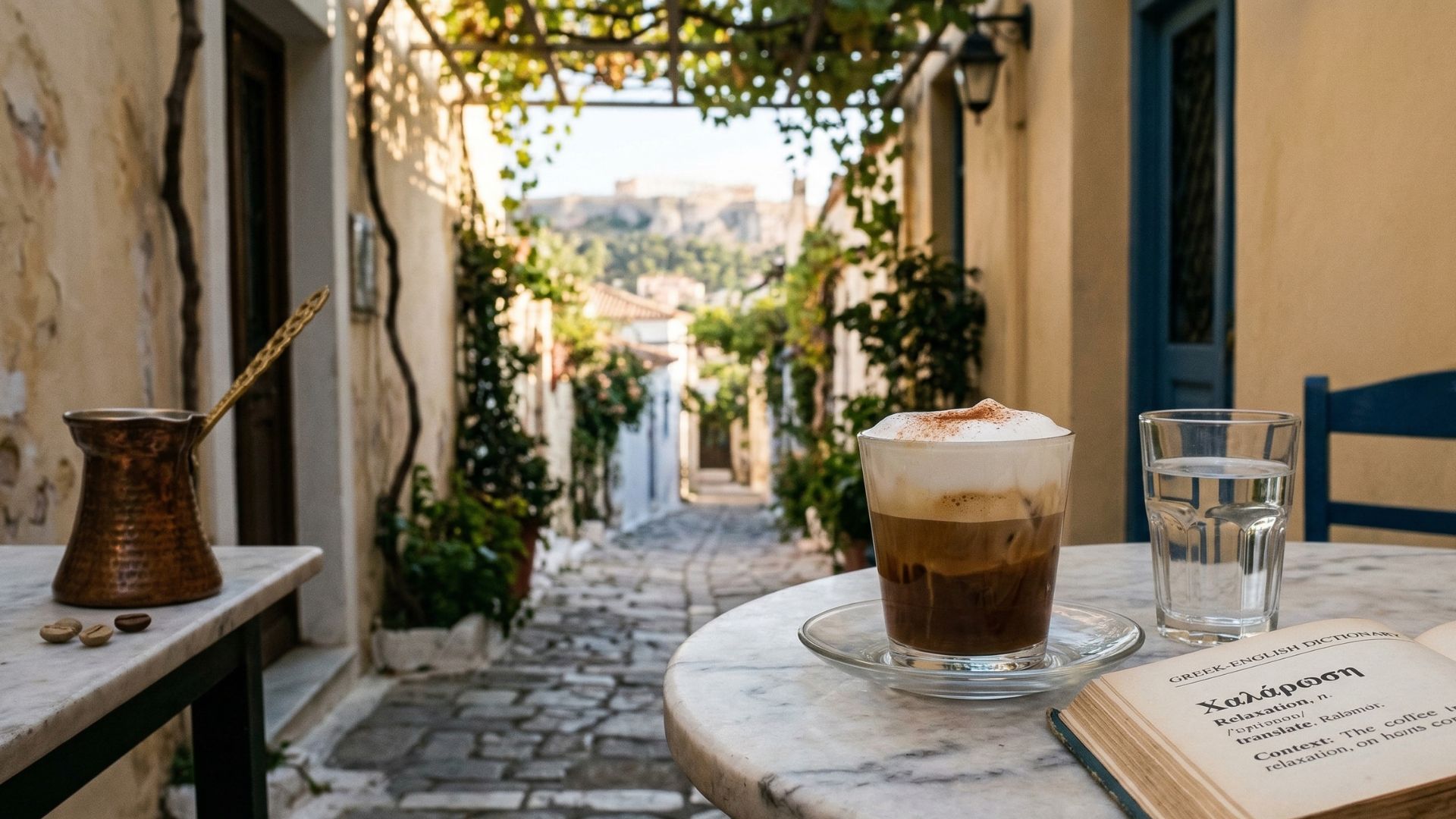
For someone with a barista background, the Freddo Espresso is fascinating because it requires a specific type of emulsification. It isn't just espresso poured over ice. A true Freddo Espresso involves extracting a double shot of espresso and immediately placing it in a professional electric mixer (shaker) with two cubes of ice and sugar (if requested). The goal is to drop the temperature instantly while creating a stable, velvety foam known as "kaimaki."
The Freddo Cappuccino takes this complexity a step further. It is topped with a thick layer of "afrogala," which is cold-frothed milk. Achieving the perfect afrogala is an art form. It needs to be made from low-fat, ice-cold milk and beaten until it has the consistency of heavy cream or melted ice cream. It should sit on top of the coffee without mixing, creating a beautiful contrast of layers.
The Classics: Greek Coffee and the Nostalgic Frappé
While the Freddo dominates the modern scene, you cannot ignore the roots. Greek Coffee (Ellinikos Kafes) is the heart of the traditional "Kafeneio." It is brewed in a small copper pot called a "briki." It is unfiltered, meaning the fine grounds settle at the bottom of your cup. It’s a slow, methodical drink meant for long conversations. Many people compare it to Turkish coffee, but in Greece, it is firmly "Ellinikos." Personally, as someone used to filtered coffee, it took me a while to appreciate the earthy, heavy body of this style, but it is undeniably the soul of the country.
Then there is the Frappé. Invented by accident in Thessaloniki in 1957, it’s made from instant Nescafé, water, and ice. As a barista who used to roast his own beans, the Frappé was my "enemy" for a long time. It reminded me of the cheap coffee I drank just to stay awake during university exams. But there is something undeniably "Greek summer" about the sound of a straw hitting the ice in a tall Frappé glass. It’s a piece of history that still holds a place in the hearts of many, even if the younger generation has largely moved on to the Freddo.
The Golden Rule of Sugar: Decide Before You Order
One of the most important cultural differences in Greece is that the barista is the one who adds the sugar. Unlike in London or New York, where you add your own sugar at a side table, in Greece, the sugar is incorporated into the drink while it’s being mixed or brewed.
As a barista, I always advocate for drinking coffee "Skétos" (plain) to truly taste the notes of the bean. However, if you prefer some sweetness, you must know your "sugar level" before you reach the counter:
-
Skétos (Σκέτος): No sugar. This is the best way to judge the quality of the cafe.
-
Métrios (Μέτριος): Medium sweet. This usually means one teaspoon of sugar, creating a balanced, bittersweet taste.
-
Glykós (Γλυκός): Sweet. This is usually two or more teaspoons of sugar. Be careful, a Greek "Glykós" can be very sweet!
Your Mini-Lesson: How to Order Like a Local
If you want to impress the barista and get exactly what you want, follow this simple formula: [Quantity] + [Type of Coffee] + [Sugar Level].
Here are the most common phrases you will use:
-
One Freddo Espresso, plain, please: Ena freddo espresso sketo, parakalo.
-
One Freddo Cappuccino, medium, please: Ena freddo cappuccino metrio, parakalo.
-
A traditional Greek coffee, please: Enan elliniko kafe, parakalo. (The waiter will then ask: "Pos ton pinete?" – How do you drink it? You respond with: "Sketo," "Metrio," or "Glyko.")
-
The bill, please: To logariasmo, parakalo.
If you are in a rush and want your coffee to go, you can add the phrase "gia exo" (for outside). If you want to sit down and enjoy the atmosphere, just order and find a table. In Greece, "coffee time" is sacred, and no one will ever rush you to leave.
The Connection Between Language and Coffee
Moving to Greece taught me that coffee is more than just a caffeine delivery system. It is a social lubricant. It is the reason people meet, the reason they argue, and the reason they laugh. Learning how to order your coffee in Greek is often the very first step in feeling like you belong here.
When you use the local terminology, you aren't just buying a drink; you are participating in a tradition that has existed for centuries. It opens doors. The barista smiles a bit more, the conversation flows a bit easier, and suddenly, you aren't just a tourist anymore.
Take Your Next Step with Speak Greekly
Ordering your morning Freddo is a fantastic start, but it’s just the beginning of what this beautiful language has to offer. At Speak Greekly, we believe that language learning should be as enjoyable as a long afternoon at a seaside cafe.
Whether you are planning a trip to the islands or moving to Athens like I did, we are here to help you navigate the culture and the language with confidence. Ready to speak Greekly? Join our community today and let’s start your journey together.
Join Our Free Trial
Begin your Greek journey today and see how simple and motivating learning can be.
Bring a Bit of Greece to Your Inbox!
Join our mailing list to get weekly language hacks, vocabulary tips, and cultural insights delivered straight to your inbox.
We hate SPAM. We will never sell your information, for any reason.