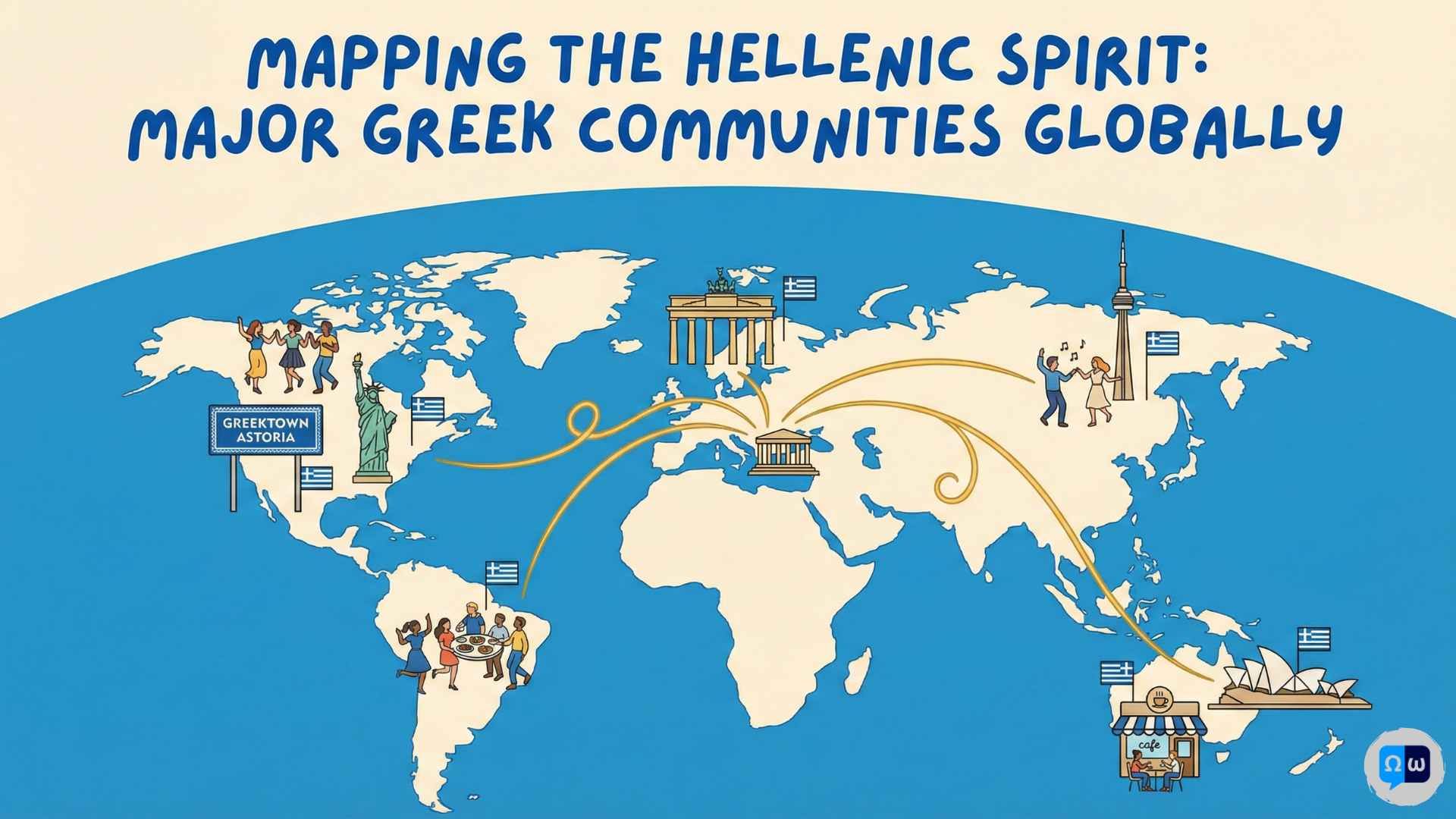
Is Greek Really That Hard? An Honest Opinion from Someone Living in Greece
Dec 23, 2025
Is Greek Really That Hard? An Honest Opinion from Someone Living in Greece
By Joaquim Queiroz
When we think of Greece, the first images that come to mind are paradise beaches, white houses with blue roofs, and, of course, ancient history. However, for those who decide to dive deeper into this culture, an inevitable barrier arises: the language.
The Greek language is undoubtedly one of the oldest and most influential in the world. Its existence dates back about 3,000 years, and although it is spoken by a small percentage of the global population (compared to English or Spanish), it enchants us with its history and influence on Western civilization as we know it today.
However, two things are striking about Greek: it is considered a beautiful language, but it also carries the reputation of being extremely difficult. In Brazil, my home country, we even have a popular expression for this: we say "you are speaking Greek" (está falando grego) when someone says something impossible to understand—similar to the English idiom, "It's all Greek to me."
But then, how difficult is it really to learn Greek? Is it an impossible beast to tame, or is it just a matter of method? Below, I share my personal and honest view as someone who changed their life to move to Greece.
My Language Background Before Greece
I have always enjoyed learning languages and considered that I had a knack for it. English came naturally, mainly because I used it in my daily professional life and consumed content on the internet.
Likewise, Italian came into my life due to the strong connection I have with Italian culture. What these two languages had in common—and what facilitated my learning—was the Latin alphabet. Therefore, I never needed many intensive private lessons; I managed to learn alone, using online platforms and popular apps. I had autonomy.
However, destiny prepared a surprise for me. In 2021, life took me to beautiful Greece. After meeting my wife in Lisbon, we decided to live in her country to raise our son, Stefanos. I arrived on Hellenic soil with a high degree of confidence to learn this new language. After all, if I had mastered English and Italian on my own, why would Greek be any different?
The Reality Check: Greek is Not Like the Others
Within the first few months, I realized that the reality would be different. The Greek language came with obstacles that, until then, I had not faced in other languages.
The first major challenge was the scarcity of tools. Unfortunately, I did not have access to a good language platform that was dynamic. The same famous platform that helped me a lot to learn English and Italian does not provide a Greek course for Portuguese speakers (and the English version is limited). Furthermore, other options on the market are very generic, limited to repeating set phrases without explaining the grammatical logic or promoting real interaction.
The Challenge of the Greek Alphabet
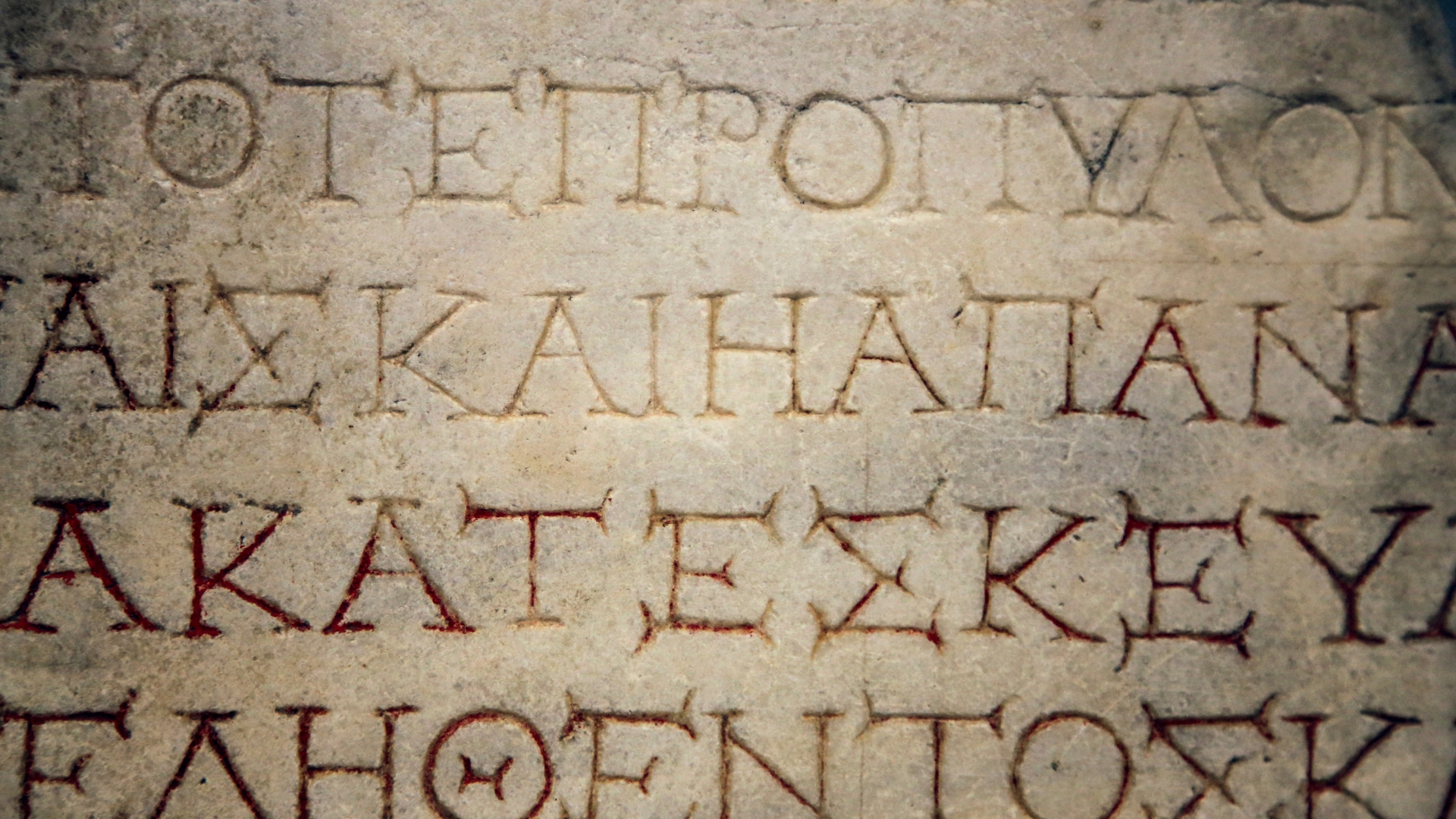
Another important point was the alphabet. It was completely different from everything I knew. Imagine the mental confusion: some letters that for over 30 years I read as "u", now, in the Greek alphabet, turned into "i" sounds.
And it didn't stop there. There isn't just one "i" sound. Greek has about five different ways to write the "i" sound (Iota, Eta, Ypsilon, etc.), depending on the historical spelling of the word. As a result, studying alone became an arduous and, often, frustrating task. My initial confidence began to diminish.
The "Demotivation Phase" While Living in Greece
In the meantime, I tried to join group classes. However, with a heavy work routine and the arrival of a baby at home, I ended up not being able to keep up with the class's pace. Falling behind in class left me demotivated.
It seems ironic, but even living in Greece, I wasn't practicing the language. Since I worked remotely for a tech company, providing support exclusively in English and Portuguese, I spent the whole day in a "linguistic bubble." I almost never heard Greek during my business hours.
Thus, the great advantage of living in the native country of the language was not being utilized. I lived in Greece, but my mind was abroad. Consequently, demotivation hit hard. I needed a change of strategy because the self-taught method that worked for Italian was not working here.
The Turning Point: Overcoming Initial Difficulties
That was when my wife noticed my struggle and stepped in to help. We started having lessons together and focusing on structured learning. Although at times it wasn't easy (after all, having lessons with your spouse has its challenges!), it was the push I needed.
Suddenly, I realized there was a logic behind that "chaos" of letters. It's like the weather: you don't notice the change day by day, but when you look back, everything has changed. The new alphabet started to feel natural.
I remember the feeling of walking down the street, looking at store signs, and simply being able to read and understand. It was as if I had installed a natural "Google Lens" in my eyes. Before, I saw symbols; now, I saw words, sounds, and meanings. Even having the impression that I didn't know all the grammar rules yet, the reading block had disappeared.
As a result, studying became much more fluid and enjoyable. Climbing Mount Olympus no longer seemed like an impossible challenge. Because of this, my adaptation to the country became even better.
I started feeling that confidence again to pick up a book and study alone, without it being exhausting. As well as that, I started to enjoy paying attention to Greek TV or sharpening my ears when listening to people talking in coffee shops and on the street.
Sometimes, I would ask my wife: "They are talking about politics, right?" or "Did they mention that food?". And, often, I was right. This was extremely encouraging, as it validated my effort and motivated me to want to learn more.
Truly Connecting with Greek Culture
Many people say: "Oh, in Greece everyone speaks English, you don't need to learn Greek." Despite it being true that Greeks speak excellent English—after all, it is a country focused on tourism—speaking the local language completely changed my experience.
Speaking Greek helped me connect truly with the people and the soul of the country.
When I ventured to speak in their language, I noticed that the interaction changed instantly. The smile on the bakery attendant's or the neighbor's face was different. The connection became more authentic. In fact, I felt that I was entering Greek Culture and was no longer seen just as "another tourist" or a passing foreigner.
In this way, doors opened to deeper experiences:
- I started discovering places off the tourist route, where usually only Greeks spend their holidays;
- I could frequent typical tavernas where there is no menu in English;
- I even managed to follow some conversations about Greek politicians (and, of course, understand their complaints, which is a national sport!).
Habits and Traditions
This linguistic immersion also brought me closer to traditions. A striking example was my relationship with the Orthodox Church. When I moved to Greece, so we could get married in the Church, I converted from Catholic to Orthodox. It was an experience very much in the style of the movie "My Big Fat Greek Wedding," full of rituals and meanings that I only fully understood by understanding the language.
Additionally, I began to adopt deep-rooted Greek habits. A classic one is drinking Freddo Espresso (the sacred iced coffee of the Greeks), even in winter. Something that, as a Brazilian used to hot coffee, I thought I would never do. Or using some facial and hand gestures that are very typical for Greeks to say "no" or "what do you want?", without needing to say a single word.
Conclusion: Is the Effort Worth It?
Is learning Greek difficult? The honest answer is: it depends on how you face the challenge.
In short, although the Greek language presents initial barriers—especially the alphabet and the lack of learning materials in Portuguese (or other languages)—it is not impossible. The secret lies in the methodology.
Learning with a teacher (or a method) that is organized, dynamic, and human makes all the difference, especially in the beginning, in the phase where you need to "unlock" your brain for the new alphabet.
After this unlocking, everything changes. Greek stops being noise and becomes music. It starts to be processed by the brain in a way similar to the root of our own languages (since Portuguese and English draw heavily from Latin and Greek sources).
Therefore, if you have the will to learn, my advice is: do not depend only on apps. Seek context, seek culture, and, if possible, human guidance. If you want to shorten this path and start the right way, I invite you to discover the Speak Greekly method. The reward of understanding this ancient civilization in its original language is priceless.
Join Our Free Trial
Begin your Greek journey today and see how simple and motivating learning can be.
Bring a Bit of Greece to Your Inbox!
Join our mailing list to get weekly language hacks, vocabulary tips, and cultural insights delivered straight to your inbox.
We hate SPAM. We will never sell your information, for any reason.